


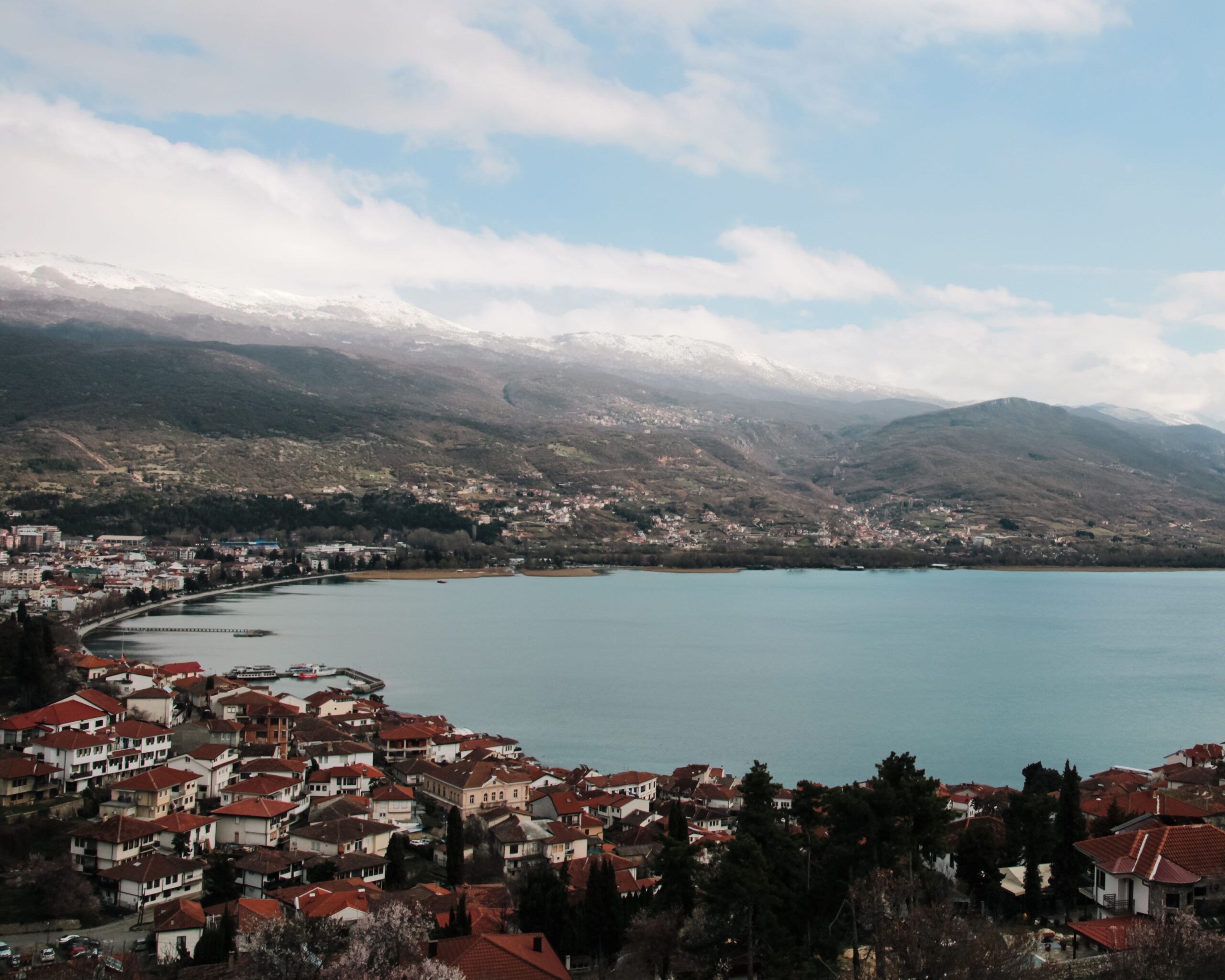
Beyond Skopje and Ohrid: A Slower Loop Through North Macedonia
Most trips to North Macedonia follow the same two-stop pattern: a couple of days in Skopje, then a transfer south to Ohrid for the lake. It is an easy itinerary to fall into, and it skips almost everything in between — a Roman city with sixth-century floor mosaics, a national park protecting an endemic pine, one of the warmest wine districts in the Balkans, and a limestone canyon twenty-five minutes from the capital. None of it is far apart. The country is small enough to cross in an afternoon, and the stops below string together into a loop of four or five days without a single long transfer.
Bitola, the City That Used to Run the Region
Bitola sits on the Pelagonia plain roughly 185 km south of Skopje, close to the Greek border. Under the Ottomans it was Manastir, the administrative seat for much of the surrounding territory and a posting for foreign consuls — enough of them that the city still trades on the nickname “city of consuls”, and several consulates are still in operation.
The evidence is on Širok Sokak, the pedestrian street through the centre. The name translates as “wide alley”, the present street dates from the reign of Sultan Abdul Hamid II, and its neo-classical façades were built for a nineteenth-century administrative class, not for visitors. The Officers’ Hall and the Co-Cathedral of the Sacred Heart both stand on it. In practice it functions as the town’s living room: coffee in the morning, a slow walk up and down in the evening, no particular pressure to be anywhere.
Heraclea Lyncestis
Two kilometres south of the centre lies Heraclea Lyncestis, founded by Philip II of Macedon in the middle of the fourth century BC and later a station on the Via Egnatia, the Roman road running from Byzantium to the Adriatic. The theatre was built under Hadrian and went out of use in the late fourth century, when gladiatorial combat was banned.
Most people come for the floor mosaics. The narthex of the Great Basilica holds a mosaic of about 100 square metres, dated to the late sixth century and worked with birds, trees and animals in a style that belongs to early Byzantine art rather than to Rome. A smaller basilica nearby combines opus sectile and opus tessellatum, and the episcopal residence excavated in the 1970s has mosaic floors of its own. The site covers around four hectares, some 1,300 square metres of it under mosaic. Come early or late — the panels are outdoors, and midday glare flattens the colour out of them.
Pelister and the Molika Pine
Pelister National Park begins in the hills immediately above Bitola, close enough to reach without committing a whole day. Declared in 1948, it was the first national park in what was then Yugoslavia and remains the oldest protected area in the country, covering about 17,150 hectares that rise from roughly 890 metres to the 2,601-metre summit of Pelister itself.
The reason for the protection is the molika, or Macedonian pine (Pinus peuce), a relict species first described in 1843 that forms dense stands between about 1,200 and 1,600 metres. Some individual trees are more than two hundred years old, and the forest has a stillness to it that the lower valleys do not. Higher up sit two glacial lakes at around 2,200 metres, known locally as Pelister’s Eyes. Reaching them is a full day’s walk and needs decent weather; anyone short on time can drive the park road, walk an hour among the pines and look back over the plain toward Greece.
Tikveš: Kavadarci, Negotino and Two Grapes
The Tikveš district, in the Vardar valley, accounts for something like four in five of the country’s wineries. It is hot and dry, with well over 200 sunny days a year, and the vineyards run right up to the motorway. Kavadarci and Negotino are the working towns at its centre, about 10 km apart and neither prettified for tourism.
Tikveš Winery in Kavadarci was founded in 1885 and is among the largest in southeastern Europe. Stobi sits beside the Roman ruins of the same name, and Popova Kula, further north at Demir Kapija, has rooms attached, which solves an obvious problem. Two grapes carry the region. Vranec is the national red: dark, full-bodied, blackberry and sour cherry, firm when young and rounder with a few years on it, and North Macedonia has more of it planted than anywhere else on earth. Stanušina is the rarer proposition — genuinely indigenous, grown almost only in Tikveš, close to extinct within living memory and now made into pale reds and rosés that taste nothing like the Vranec beside them.
Tasting and driving do not combine, and this is the one leg of the route where hiring a car looks like a mistake. Either book a driver for the day or sleep at a winery and walk back to your room.
Matka Canyon, Twenty-Five Minutes From Skopje
Matka is 17 km southwest of Skopje, about twenty-five minutes by car, and it works as a first or last day rather than a destination in itself. The Treska river was dammed here decades ago; the resulting reservoir is the oldest artificial lake in the country, and it fills the canyon floor between walls steep enough to feel much further from a capital than it is.
There are ten caves in the canyon, ranging from 20 to 176 metres in length, plus two vertical pits of around 35 metres. The one visitors see is Vrelo, on the right bank of the Treska, an underwater system reckoned to be among the deepest in Europe and containing two lakes inside the cave itself. Boats run to it from the dam; kayaks are there for anyone who would rather work for the view. Three monasteries sit in or above the canyon — St Andrew’s, founded around 1388, the fourteenth-century Matka monastery, and St Nicholas Šiševski on the cliff. Some 20 percent of the plant species here are endemic and 77 butterfly species have been recorded, which explains the people moving very slowly along the shoreline path with a camera.
A Workable Order for the Drive
- Skopje to Matka and back — 17 km each way, roughly 25 to 30 minutes. Half a day is enough, and it makes an easy first morning on local roads.
- Skopje to Kavadarci — about 100 km, an hour to an hour and a half on the A1. Add time for the Demir Kapija gorge, which is worth pulling over for.
- Kavadarci to Bitola — around 90 km by road, but on regional roads through Prilep rather than motorway, so allow an hour and a half.
- Bitola, Heraclea and Pelister — two nights, almost no driving beyond the short run up into the park.
- Bitola to Ohrid — about 70 km, an hour and a quarter, climbing over the pass by Resen and dropping to the lake.
How the Lake Fits at the End
Arriving in Ohrid from Bitola rather than from Skopje changes the experience of the place. After Heraclea, the churches and the fortress read as one more layer of the same long story instead of a standalone attraction, and after the dry Tikveš heat the water is a straightforward relief. Most itineraries allow a night and a morning, which is enough to walk the old town and no more, and it is the reason so many travellers end up spending longer in Ohrid than they intended to. Booking the final nights loosely, rather than fixing a departure date before leaving home, tends to head that off before it becomes an argument about flights. The wider point holds for the whole route: the distances are short, the roads are decent, and the parts of the country worth slowing down for are not the ones with the queue outside.
The Takeaway: Slow Down and See More
North Macedonia rewards the traveller who resists the obvious two-stop itinerary. Skopje and Ohrid deserve their place, but the slower loop through Matka, Tikveš, Bitola and Pelister adds the things a rushed route misses: Roman ruins without crowds, mountain forests, small wineries, old streets and long stretches of road where the country feels like itself rather than a collection of attractions.
The distances make this unusually easy to do. Give the middle of the country a few days, finish at the lake, and the journey becomes the experience rather than something to get through between two famous stops.

